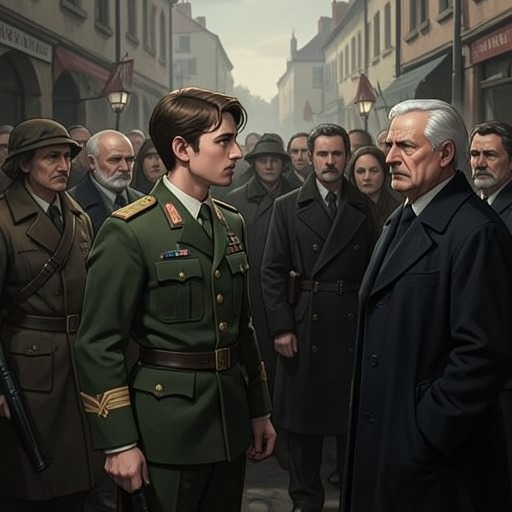
Marius and Georges Pontmercy
Les MisérablesMarius and Georges Pontmercy are father and son separated by family authority and political allegiance, and their relationship becomes a story of belated recognition. Marius grows up believing that Georges abandoned him and did not love him; Georges, meanwhile, asks to see his son when he knows he may be dying. By the time Marius begins to understand the father he never knew, Georges is dead. The son can inherit his father’s name and convictions, but cannot repair their separation in person.
Family Separation and Political Inheritance
Georges Pontmercy is a veteran of the Napoleonic Empire, made a colonel and baron by Napoléon Ier. After Georges’s wife dies, her father, M. Gillenormand, takes Marius away to raise him according to his own principles. The separation therefore begins not with a choice made by the boy, but with a family arrangement that places him in the household of a man hostile to his father’s politics. The Bourbon Restoration also denies Georges the titles he had earned, making their dispute over family identity part of a broader conflict over the legitimacy of the past.
M. Gillenormand’s influence shapes what Marius thinks he knows. He calls Georges a sabreur in one of his more indulgent moments, but his royalist hostility runs deeper than the nickname: Marius is raised apart from his father and receives an account of him filtered through contempt for the Empire and its supporters. The boy consequently interprets absence as evidence of indifference. Because he does not feel loved, he does not love in return; what might have been a bond of affection is, to him, an abstract and unwelcome obligation.
A Reunion That Comes Too Late
In 1827, when Marius is seventeen, M. Gillenormand tells him that he must go to Vernon to see his sick father. The news surprises him: he had not imagined that he might have to meet Georges. He experiences the summons as a forced approach to someone he dislikes, not as an opportunity to recover a lost relationship. His political antipathy reinforces the personal estrangement, while the belief that Georges left him to others seems to confirm that he was never loved.
Georges has been ill with a cerebral fever for three days. At the beginning of the illness, troubled by a foreboding, he writes to M. Gillenormand and asks for his son. As the illness worsens, he becomes delirious and cries that Marius has not arrived; he tries to rise and go out to meet him, falls in the passage, and dies on the evening Marius reaches Vernon. The doctor arrives too late, the priest arrives too late, and the son arrives too late. The timing makes the proposed reunion an absence made final: Georges’s request for Marius is answered only by the son’s arrival at the bedside of a dead man.
The scene gives Marius his first and last view of his father. A tallow candle lights Georges’s body, watched over by a doctor and a praying priest. On the dead man’s cheek lies a large tear that has not dried. The narrative makes that tear the visible mark of the delay, concentrating Georges’s final longing and Marius’s missed arrival in a single detail. Marius also sees the evidence of a life of military service on the body: sabre scars and the red marks of bullet wounds, alongside a great scar that gives the face its heroic aspect. He recognizes that this stranger is his father, but recognition does not immediately produce intimacy. His grief is no greater than he would have felt for another dead man.
The Letter and the Father's Legacy
Conscious of his own lack of feeling, Marius becomes ashamed and embarrassed under the gaze of the doctor, priest, and servant. He drops his hat so that his weakness might be taken for grief, then feels remorse at having staged an emotion he does not possess. His discomfort does not erase the estrangement; it exposes the distance between the expected duties of a son and the feelings formed by years of separation.
Georges leaves almost nothing. The sale of his furniture barely pays for his funeral, and a servant gives Marius a scrap of paper in his father’s handwriting. The note asks his son to take and bear the baronial title Georges received on the battlefield at Waterloo, a title the Bourbon Restoration disputes and which, Georges insists, was paid for with his blood. He adds that Marius should be worthy of it. The paper is thus both a material inheritance and an appeal across the gap between them: Georges cannot raise his son, but he can still entrust him with a name and the responsibility attached to it.
The note also records a debt of gratitude. At Waterloo, a sergeant named Thénardier saved Georges’s life. Georges asks Marius to do whatever good he can for the man if they meet, and mentions that Thénardier may have kept a small inn in a village near Paris. This request connects Georges’s memory of his own survival to an obligation he passes on to his son. Marius preserves the scrap, not from devotion to his father, but from the powerful respect the presence of death commands. At this stage, the gesture is more a response to the dead than evidence that the relationship has been repaired.
Recognition After Death
Marius stays in Vernon for only forty-eight hours. After the funeral he returns to Paris and resumes his legal studies, scarcely thinking of Georges; within days, his father is effectively forgotten, and the crape on his hat is almost the only outward sign of mourning. The interval between this conduct and his later transformation matters: Marius does not leave the deathbed already reconciled to his father’s memory. Understanding has to come later, through another person’s testimony.
By chance, Marius meets one of Georges’s former companions. What he learns makes him sensitive to his father’s republican ideals and imperial sympathies, changing the political meaning of the life he had previously dismissed. He comes to love and respect Georges too late to tell him so. In tribute, he has calling cards engraved in the name of Baron Marius Pontmercy, accepting the title his father asked him to bear. The cards turn a private message into a public declaration: Marius now claims the name and history that M. Gillenormand’s household had taught him to reject.
Conflict, Continuity, and Significance
The change in Marius’s understanding alters his relationship with M. Gillenormand. When his grandfather declares himself to be Marius’s father, Marius answers by honoring Georges as a humble and heroic man who served the republic and France, endured years in the field, took two flags, suffered many wounds, and died forgotten and abandoned. He understands his father’s great fault to have been loving two ingrates: his country and his son. M. Gillenormand cannot accept this account. His rejection of the republican cause and his denunciation of Georges’s political world turn Marius’s newly recovered filial allegiance into an open family conflict.
That confrontation reveals the irony at the center of the father-son relationship. Marius first experiences his father as an intruder in a life organized by his grandfather; only after Georges’s death does he see how political hostility and enforced distance shaped that impression. Georges’s request for his son, the tear on his cheek, and the letter asking Marius to bear his title establish a continuing bond, but the bond reaches Marius through signs and testimony rather than shared life. His eventual respect is real, yet it cannot undo the missed meeting. The relationship therefore links private grief to inherited political memory: to recognize Georges as a father, Marius must also recognize the convictions and history that had been suppressed in his upbringing.